
Lateral Field & Leach Field Repair in Northeast Kansas
Whether you call it a lateral field, a leach field, or a septic drain field, it does the hardest work in your septic system. Wheatland Plumbing and Septic diagnoses, repairs, and replaces failing lateral fields across Leavenworth County, Douglas County, Topeka, and the Highway 36 corridor. We check the tank, distribution box, and lines first so you never pay for a full field replacement if a simpler repair will fix it.
- Serving NE Kansas Since 2010
- Licensed Plumbing & Septic Contractor
- IAPMO Member & Former Chapter President
- Family-Owned, No Subcontractors
Who we've worked with
Posted on Google
 Kamren Nielsen
Trustindex verifies that the original source of the review is Google.
Wheatland Contracting has been an absolute pleasure to work with. Their team is professional, responsive, and consistently focused on delivering the best possible experience for their customers. Every interaction showed their dedication to quality and client satisfaction. I highly recommend Wheatland Contracting to anyone looking for a reliable and customer-first company.Posted on Google lupinevirOur Heros! Steve from Wheatland Contracting came out to fix a stubborn grease blocakge in the septic system. Professional, courtous, and hard working. Thank you Steve!Posted on Google
 Alyssa RichardsonHad Troy out to pump and inspect my septic tank before buying my first house. He is Amazing at his job walked me through where everything was at how everything looked and answered any questions that I had regarding my septic!Posted on Google
 John WentlingGreat customer service! Friendly and knowledgeable staff. Called for septic issues, that were urgent, and Troy was out same day to resolve our problem!Posted on Google
 Jennie BowenTroy is amazing! Honest and so helpful.Posted on Google
 Jeana McLeesThey were able to fit us in the day we called despite their tight schedule, very much appreciated! They made quick work of the clogged sewer drain. Showed up earlier than estimated. Price was fair. Personable employees. I will call again with any future plumbing needs!Posted on Google
 Ana WhiteCalled Friday and had someone come out great team very professional they solved my problems and saved my whole life thank you thank you and thank you againShowing only 4-5 star reviews
Serving Leavenworth County, Douglas County, and Northeast Kansas
In Kansas, most homeowners and county sanitary codes call the absorption trenches a lateral field (national guides often call it a leach field or drain field). Every gallon of water that leaves your house has to pass through the septic tank and soak into the soil through those perforated lateral lines. When the field stops taking water, sewage has nowhere to go except up into the yard or back into the house.
Wheatland Plumbing and Septic is based in Effingham and has worked on rural septic systems across Northeast Kansas since 2010. We repair and replace lateral fields throughout Leavenworth County (Tonganoxie, Basehor, Lansing, Easton, and Linwood), across Douglas County (Baldwin City, Eudora, and rural Lawrence), in Topeka and Oskaloosa, and along the Highway 36 towns (Holton, Hiawatha, Seneca, and Sabetha).
Soil and terrain across Northeast Kansas play a big role in why lateral fields fail and how they have to be repaired:
- Heavy clay soils: Along the Missouri River bluffs in Leavenworth and Atchison counties and across southern Douglas County, tight clay soils drain slowly. Lawrence-Douglas County Public Health notes that lateral fields in slow-draining clay soils must be built about 50 percent larger than fields in faster-draining soils.
- Sloped ground and drop boxes: According to KDHE standards for soil absorption systems, at least four feet of suitable soil is required below the absorption trenches, laterals must follow the contour and stay level, and slopes greater than 1.5 percent should use serial distribution with drop boxes so effluent does not rush to the lowest trench and flood it.
- County permit rules: Under the Leavenworth County Sanitary Code, replacing or adding absorptive laterals is a structurally significant alteration that requires a county permit and inspections before the trenches are covered.

What's Included in Lateral Field Diagnosis & Repair
System-Wide Diagnosis First
- We start with a septic inspection and tank check to see if the symptom is actually a full tank, a plugged effluent filter, a broken outlet baffle, or a crushed pipe between the tank and the field rather than a dead leach field.
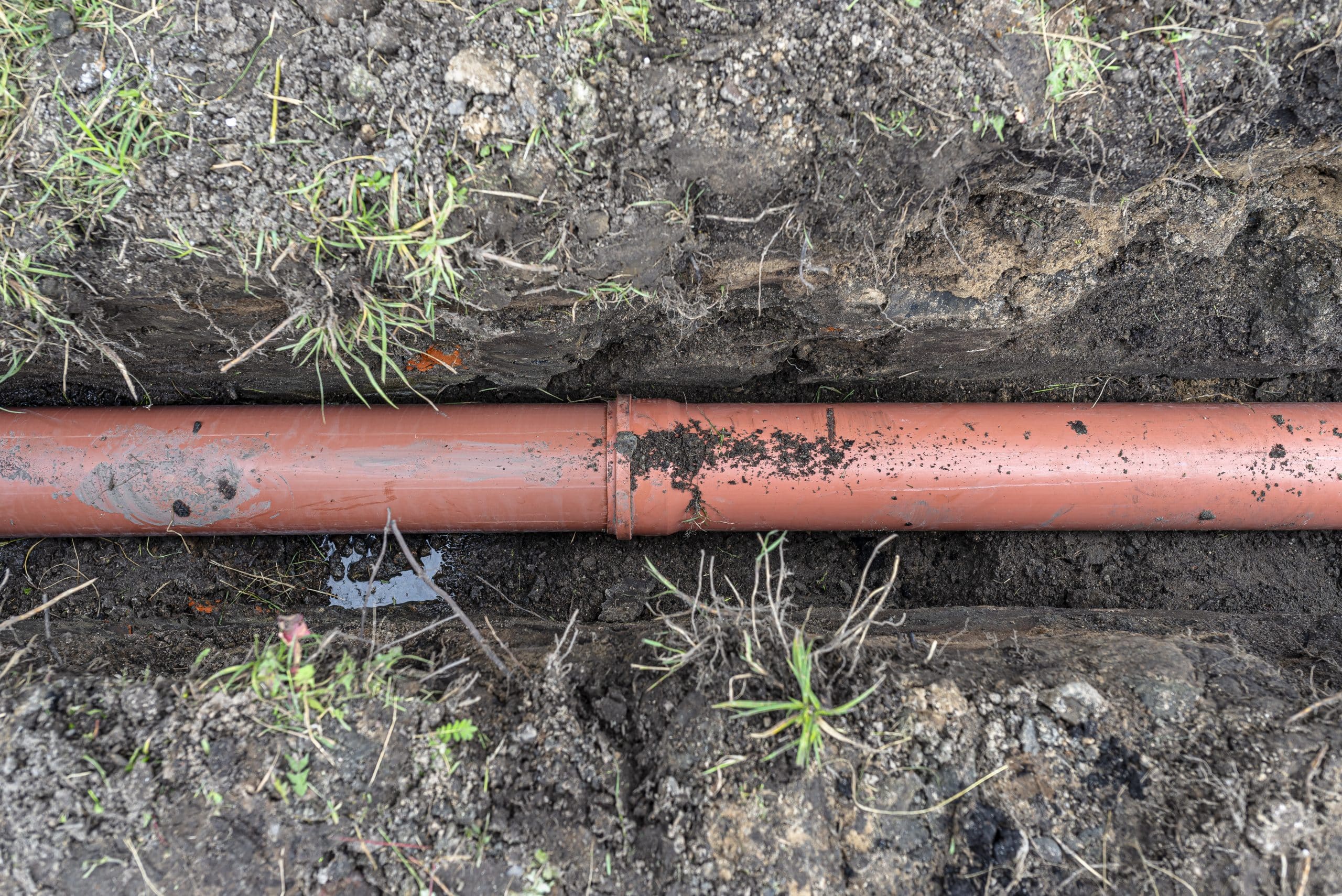
- Checking the solid pipe from the tank to the first distribution box or drop box for tree roots, equipment damage, or settled low spots.
Distribution Box, Drop Box & Header Line Repair
- Often only one or two trenches are taking all the water because a distribution box tipped, settled, or cracked. Replacing or re-leveling the distribution box or drop boxes gets the whole lateral field working evenly again without digging up every trench.
- Clearing or replacing root-choked header lines that feed the absorption trenches.
Lateral Line Addition & Trench Replacement
- Where county rules and lot space allow, adding new absorption laterals or replacing crushed and biomat-choked trenches in suitable soil.
- Ensuring trenches stay level along the contour of the land with the four feet of suitable underlying soil required by KDHE guidance.
Full Absorption Field Replacement
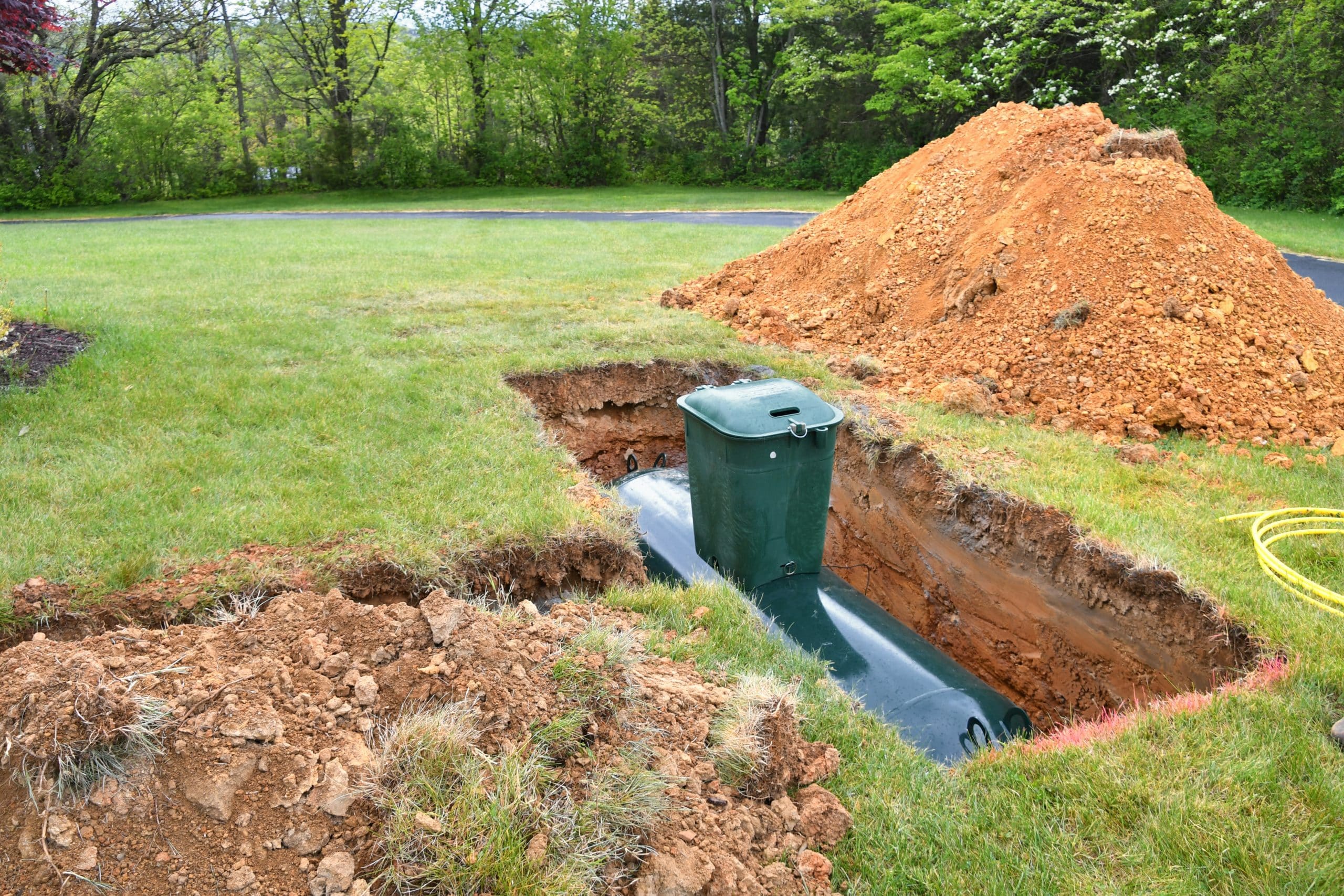
- When an old field is completely saturated with solids because a tank went decades without pumping or was driven over by heavy equipment, we design, permit, and excavate a replacement lateral field in your lot’s designated replacement area.
- If the tank itself is also cracked or undersized, we can replace the septic tank at the same time.
Our Lateral Field Repair Process
Step 1: Inspect Before We Dig. We start by inspecting the septic tank, outlet baffle, and solid header pipe. We want to be sure the water on your lawn is truly a lateral field failure and not an outlet blockage or a leaking tank.
Step 2: Locate the Field & Check Soil/Permits. If the laterals are the issue, we map the existing trenches, check available yard space and well setbacks, and coordinate any required county soil evaluation and repair permit.
Step 3: Honest Repair vs. Replace Quote. If fixing a crushed header pipe or distribution box will solve the issue, we quote that repair. If the trenches are failed and need new laterals, we give you a clear quote for the permitted lateral work.
Step 4: Excavation & Trench Work. Our in-house crew excavates the repair area or cuts new level lateral trenches along the contour, sets chambers or rock-and-pipe trenches per county code, and installs cleanouts or drop boxes as needed.
Step 5: County Inspection & Final Grade. For permitted lateral replacements, the county inspector checks the open trenches before cover. We then backfill, mound the soil slightly for settling, and mark the field so trucks and tractors stay off it.
What Affects the Cost of Lateral Field Repair in Northeast Kansas?
Lateral field jobs range from a simple distribution box or header-pipe repair to a full absorption field replacement. Because every lot is different, we inspect the site before quoting. Your cost depends on:
- Whether it is a spot repair or a full field replacement: Fixing a crushed pipe between the tank and the field or replacing a tilted distribution box is a fraction of the cost of excavating an entire new lateral field.
- Soil percolation and clay content: Slow-draining clay soils in Douglas, Leavenworth, and Johnson counties require more linear feet of trench than loamy soil.
- Slope and distribution method: Flat lots can use level Equal Distribution, while sloped rural lots over 1.5 percent require serial drop boxes stepped down the contour.
- Lot access and obstacles: Tree roots, long runs around outbuildings, fences, or tight property lines affect excavation time.
- County permit requirements: Adding or replacing absorptive laterals requires a county permit and inspection in Leavenworth, Shawnee, Douglas, Jefferson, and Johnson counties.
Why Choose Wheatland for Lateral Field Repair
We Check the Simple Fixes First
A wet spot near the tank or a slow drain does not automatically mean you need a costly lateral field replacement. We check the tank level, outlet tee, and solid header pipe first so you only pay for what is actually broken.
Built for Northeast Kansas Clay & Slopes
From the river bluffs in Leavenworth and Atchison to the heavy clay outside Baldwin City and the farm ground along US-36, we build and repair lateral fields for the soil you actually have.
In-House Crew, No Subcontractors
Our own team runs the excavator, laser level, and plumbing gear. You deal with one local company from start to finish.
Family-Owned Since 2010
Jeff and Stacie Coder own and run Wheatland Plumbing and Septic out of Effingham, bringing more than 30 years of industry experience to every job.
IAPMO Member and Former Chapter President
Jeff Coder is an IAPMO member and former chapter president, and we follow KDHE and county sanitary codes on every lateral repair and replacement.
Featured Project Gallery


Service Area
We repair and replace septic lateral fields across Northeast Kansas, including:
- Leavenworth County: Leavenworth, Tonganoxie, Basehor, Lansing, Easton, Linwood, Lowemont, and Jarbalo
- Douglas County: Baldwin City, Eudora, Lawrence, and Lecompton
- Highway 36 Corridor & Northern Counties: Holton, Hiawatha, Seneca, Sabetha, and Atchison
- Shawnee & Jefferson Counties: Topeka, Oskaloosa, Valley Falls, Meriden, and McLouth
- Western Johnson & Wyandotte Counties: De Soto, Gardner, Olathe, and Kansas City, KS
Related Services
Septic Tank Replacement & Installation
Full septic tank replacement and complete new septic systems when both the tank and field need an upgrade.
Septic Pumping
Regular tank pumping removes heavy sludge before it can wash out and ruin your lateral field.
Septic Inspection
Open-tank and absorption-area checks to diagnose septic issues or satisfy county home-sale requirements.
Drain Cleaning
Auger, camera, and hydro-jetting service when the clog is in the house plumbing or main building drain rather than the field.
Frequently Asked Questions
Is a lateral field the same thing as a leach field or drain field?
Yes. In Kansas, homeowners, installers, and KDHE manuals usually call the underground absorption trenches a lateral field or soil absorption system. Elsewhere in the country, the exact same part of the septic system is called a leach field or drain field.
What are the warning signs of a failing lateral field?
The clearest signs are soggy or spongy ground over the trenches during dry weather, bright green strips of grass right over the lateral lines, sewage odors outdoors, wastewater surfacing in the yard, or plumbing fixtures that still drain slowly right after the septic tank has been pumped.
Can a lateral field be repaired without replacing the whole thing?
Often, yes. If the problem is a crushed solid pipe between the tank and the field, root intrusion in the header line, a broken outlet baffle in the tank, or a tilted distribution box sending all the water down a single trench, fixing that specific part can restore the field without digging up all the trenches.
What causes a septic lateral field to fail?
The three biggest causes we see in Northeast Kansas are: (1) going too many years without septic pumping, which lets sludge overflow the tank and plug the soil trenches; (2) driving vehicles, tractors, or mowers over the field, which crushes pipes and compacts the soil; and (3) excess water from leaking toilets, sump pumps, or roof downspouts flooding the absorption area.
Do I need a permit for lateral field repair in Leavenworth or Douglas County?
If the repair involves adding or replacing absorptive lateral trenches, yes. The Leavenworth County Sanitary Code treats replacing or adding laterals as structurally significant work requiring a permit and inspections. Douglas County, Shawnee County, Jefferson County, and Johnson County also require permits whenever absorption trenches are added or altered.
Why are lateral fields larger in clay soil?
Clay holds water and drains much more slowly than sandy or loamy soil. To prevent wastewater from surfacing, county codes in clay-heavy areas like Douglas and Leavenworth counties require more square footage of trench bottom so the water has enough surface area to soak in.
How does slope affect lateral field installation in Kansas?
KDHE guidelines state that individual lateral trenches must follow the contour of the land so the trench bottom stays level. On lots with a slope over 1.5 percent, installers typically use serial distribution with drop boxes so each upper trench fills to its proper depth before overflowing into the next trench downhill.
How do I protect my lateral field after it is repaired?
Pump your septic tank on schedule based on actual sludge levels, never park or drive equipment over the lateral area, plant trees well away from the trenches, fix running toilets promptly, and direct gutter downspouts and sump pumps away from the field.
Contact Us
Let's Talk About Your Project
Seeing wet spots over your septic lines or dealing with slow drains after a pump-out? Call us at (913) 833-2304 or schedule a visit below. We will find out whether you need a simple line fix or lateral field work and give you a straight answer.
—
